


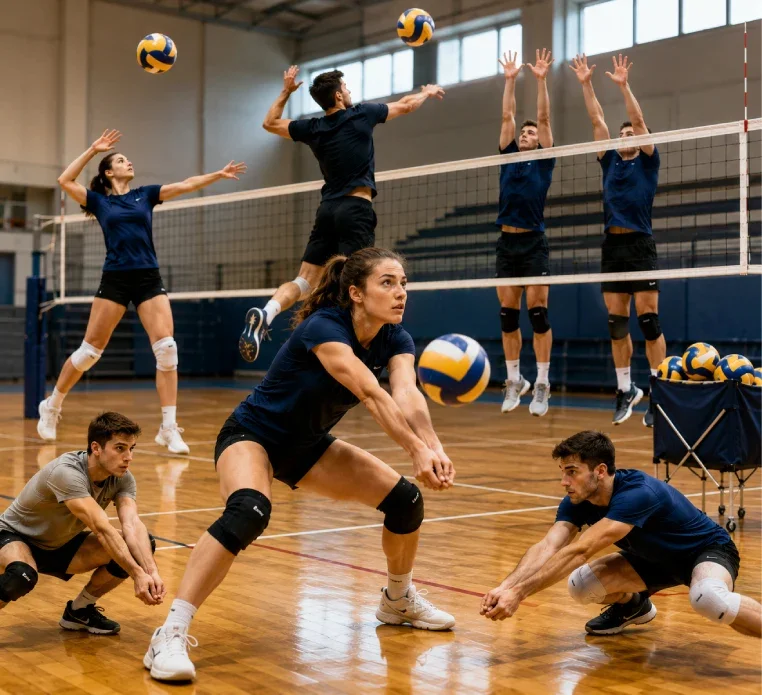
Ever watched a college or pro volleyball match and thought, “how do they make this look so easy?” Clean passes, quick sets, attacks that land exactly where they’re aimed look effortless. It isn’t. That smoothness is built, rep by rep, through consistent volleyball drills and a lot of repetition most fans never see.
Here’s the thing: players don’t get better just by playing more matches. They get better by breaking the game into pieces and grinding those pieces through volleyball training drills, building accuracy, timing, and the kind of split-second decision-making that holds up under real pressure. That’s how consistency actually gets built.
How Effective Volleyball Training Drills Actually Work
There’s a simple principle behind high-level development: isolate, repeat, integrate. You take a skill and break it down to its smallest moving part: foot positioning before a jump, hand angle on a pass, whatever it is. Then you drill that one piece, over and over, through focused volleyball training drills until it stops feeling like a “move” and starts feeling automatic. Only then do you fold it back into full game situations.
The point isn’t just knowing what to do. It’s being able to do it instantly, without thinking, when the rally’s on the line. Every drill below is built around exactly that idea.
12 Volleyball Drills Everyone Must Follow
Serving Drills
- Target Serving Drill
This one’s a favorite because it connects directly to what actually happens in a match. Instead of just getting the ball over the net, players aim corners, seams, weak zones between receivers. Serving stops being a formality and starts being a weapon.
- Setup: 4–6 marked target zones across the court
- Reps: 10–15 serves per player
- Focus: accuracy before speed or power
- Benefit: sharper tactical serving and pressure control
Do this enough and players start “seeing” targets during real matches without even trying. Confidence just follows.
- Serve and Sprint Drill
In an actual game, nobody just stands there admiring their serve you’ve got to move. This drill builds that instinct in.
- Setup: server + coach/receiver with spare balls
- Reps: 8–12 rotations per player
- Focus: immediate movement right after contact
- Benefit: quicker transitions, better court awareness
It kills that classic beginner habit of watching your own serve instead of getting ready for what’s next.
Passing Drills
- Three-in-a-Row Passing Drill
Simple idea, tough execution: three clean passes in a row, or you start over. That pressure forces players to actually care about every single touch instead of coasting through reps.
- Setup: 2–3 passers + setter target
- Goal: 3 consecutive accurate passes
- Focus: platform stability, controlled angles
- Benefit: mental focus, steadier passing under pressure
This is genuinely one of the best volleyball training drills for building a first contact you can trust.
- Pepper Drill
Pepper’s everywhere for a reason it strings passing, setting, and hitting into one continuous flow. No stopping, just rhythm.
- Setup: 2 players, 1 ball
- Duration: 3–5 minutes continuous
- Focus: ball control, reaction speed
- Benefit: overall touch and rhythm
Bonus: it doubles as a solid warm-up, since it wakes up both your hands and your reflexes at once.
Setting Drills
- Wall Setting Drill
Nothing fancy just you and a wall. But that’s exactly why it works. No pressure, no partner needed, just pure focus on hand shape and release.
- Setup: solo + flat wall
- Reps: 20–40 continuous sets per round
- Focus: soft touch, consistent release
- Benefit: muscle memory, steady hands
People sleep on this one, but honestly? It might be the fastest way to fix your setting.
- Setter Movement Drill
Real passes are rarely perfect. So why train like they will be? This drill throws random tosses at the setter, forcing movement before the set even happens.
- Setup: coach + setter + random tosses
- Reps: 10–15 varied tosses
- Focus: footwork before setting
- Benefit: adaptability, court reading
Of all the volleyball training drills on this list, this one probably mirrors game chaos the closest.
Hitting Drills
- Approach and Attack Drill
Timing beats raw power more often than people think. This one syncs footwork with the set so hitters attack at the top of their jump, not a beat too early or late.
- Setup: hitter + setter/tosser
- Reps: 10–15 controlled attacks
- Focus: jump timing, balance
- Benefit: cleaner, more efficient hitting
Most hitting problems aren’t strength problems, they’re timing problems. This fixes that.
- Line and Cross-Court Hitting Drill
Attackers who only hit one direction get read like a book at higher levels. This drill trains you to mix it up on purpose.
- Setup: hitter + setter + target zones
- Reps: alternating directions per swing
- Focus: shoulder angle adjustment
- Benefit: unpredictability on offense
Blocking Drills
- Footwork and Block Timing Drill
Blocking has less to do with how high you jump and more to do with when and where. This isolates the movement before contact even happens.
- Setup: blocker + hitter/coach
- Reps: 10–12 reps per side
- Focus: lateral movement, jump timing
- Benefit: precision at the net
- Triple Block Read Drill
Blocking as a team is a completely different skill than blocking solo. Here, three blockers have to read the attacker and move together, not as three separate people guessing.
- Setup: 3 blockers + attacker
- Reps: 10–15 attacks
- Focus: communication, alignment
- Benefit: stronger defensive structure
Defense Drills
- Dig and Recover Drill
Digging the ball is only half the job recovering fast for the next play is the other half people forget about. This drill hits both.
- Setup: defender + coach
- Reps: 10–20 quick attacks
- Focus: instant reset after the dig
- Benefit: defensive endurance
- Small-Sided Games
If you only had time for one of these volleyball practice drills, this would be it. Smaller teams mean more touches, more decisions, more responsibility for every single player on court.
- Setup: 3v3 or 4v4
- Format: play to 15–21 points
- Focus: real-game decision-making
- Benefit: overall game intelligence
Putting It All Together
You don’t need to run all 12 drills every session that’s a recipe for burnout, not improvement. A solid session usually mixes 2–4 volleyball practice drills, touching serving, passing, attacking, and some kind of game simulation.
A structure that works well:
- 1 serving drill
- 1 passing or setting drill
- 1 attacking or defensive drill
- 1 small-sided game
Simple, balanced, and nothing gets neglected.
Final Thoughts
Real improvement in volleyball doesn’t come from just racking up more matches, it comes from training with actual intention. These 12 volleyball drills are built to develop control, consistency, and game smarts, one rep at a time.
Stick with structured volleyball training drills long enough, and basic skills stop being “things you’re working on” and start becoming automatic which, honestly, is the whole difference between an average player and a genuinely good one.


