


Say the word “gymnastics” to most people, and they picture the same thing: a gymnast sticking a perfect landing on a balance beam, or flying through the air on a vault. Fair enough, that’s the image that gets the TV coverage. But it’s really just one slice of a much bigger sport.
Here’s what most people miss: gymnastics isn’t one thing. It’s an umbrella term covering several completely different disciplines, each with its own rules, scoring, equipment, and physical demands. Once you actually understand the differences between the types of gymnastics, the whole sport gets a lot more interesting whether you’re glued to the Olympics every four years or trying to pick a class for your kid.
This guide breaks it all down in plain language, so you finally know what separates one discipline from the next.
How Many Types of Gymnastics Are There?
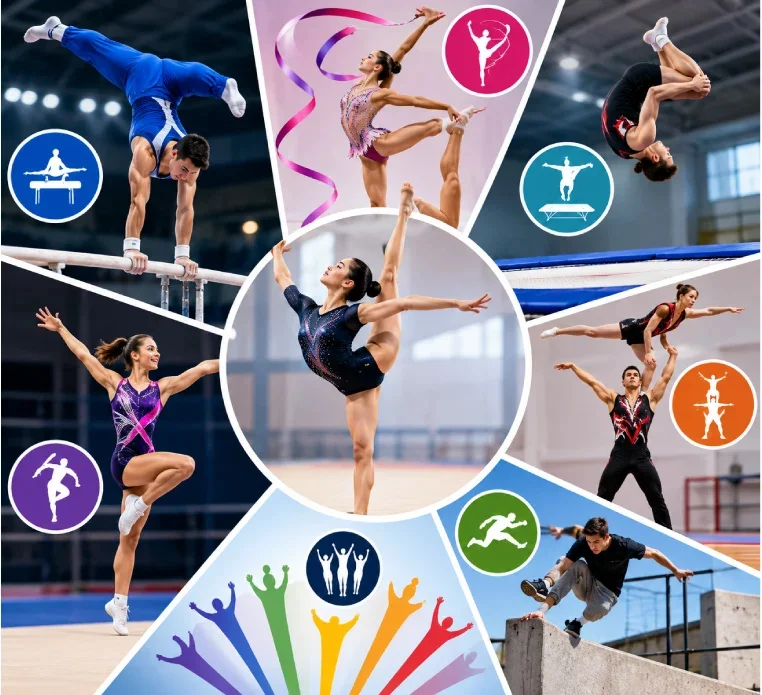
Officially, the international governing body recognizes seven disciplines:
- Artistic Gymnastics
- Rhythmic Gymnastics
- Trampoline & Tumbling
- Acrobatic Gymnastics
- Aerobic Gymnastics
- Parkour
- Gymnastics for All
That said, if you walk into a typical training center or watch a major competition, you’ll mostly see the first four in action; they’re the ones that dominate events like the Olympics and World Championships.
Each of these builds a wildly different skill set. Some are all about raw strength. Others lean into rhythm, coordination, or pure aerial control. It’s not one sport wearing different costumes, it’s genuinely several sports under one name.
Artistic Gymnastics: The Most Recognized Form
This is the one everyone pictures first. It’s the oldest, most structured, and most widely followed of all the types of gymnastics out there.
At its core, artistic gymnastics is about staying in complete control of your body under intense pressure whether that’s balancing on a four-inch-wide beam or flipping through the air on floor.
Men and women compete on entirely different apparatus, each testing a different mix of strength, balance, and precision.
Women compete on: Vault, uneven bars, balance beam, floor exercise
Men compete on: Floor, pommel horse, rings, vault, parallel bars, horizontal bar
Why it stands out
it blends power, flexibility, and precision all at once, runs on a brutally technical scoring system, and takes years of disciplined training to even approach elite level. Honestly, most people consider artistic gymnastics the foundation the other disciplines build on, since it develops such complete body control.
Rhythmic Gymnastics: Where Sport Meets Art
Now this one goes in a totally different direction. Forget bars and rings — rhythmic gymnasts perform with handheld apparatus while moving to music, and the whole thing looks more like ballet than a typical sports event.
It’s arguably the most graceful of all the gymnastics disciplines, blending dance, flexibility, and coordination into one continuous performance.
Key elements: ribbon, hoop, ball, clubs, and rope, all woven into choreographed routines set to music, performed without a single pause.
What sets it apart from power-based gymnastics is the emphasis on expression and flow — every movement has to look effortless while still nailing strict technical requirements underneath. It’s genuinely one of the more visually stunning types of gymnastics to watch, and comparisons to ballet aren’t far off.
Trampoline & Tumbling: The Aerial Discipline
Trampoline gymnastics is built around one simple idea: how high can you go, and how well can you control yourself once you’re up there?
Athletes bounce on a high-performance trampoline while pulling off flips, twists, and multi-part combinations that look effortless but actually demand serious spatial awareness and split-second timing.
Formats include individual trampoline (an Olympic event), synchronized trampoline, and tumbling, performed on a spring track rather than a trampoline itself.
What makes it unique is that it’s entirely focused on aerial movement, demands precise landing control, and gets scored on both difficulty and consistency. Of all the types of gymnastics, this one comes closest to what “controlled flight” actually feels like — which is exactly why it’s so fun to watch.
Acrobatic Gymnastics: Built on Trust and Coordination
Acrobatic gymnastics — usually just called “acro” — ditches equipment entirely and swaps it for something harder to train: human partnership. Athletes perform in pairs or groups instead of alone.
This whole discipline runs on timing, trust, and coordination between teammates. Routines include lifts and balances, throws and catches, and group pyramids and formations.
It’s performed on a spring floor, uses no traditional apparatus, and leans heavily on teamwork. Unlike the more individual disciplines, acro depends completely on synchronization — one small timing slip from one partner, and the whole routine can fall apart. It’s easily one of the most team-driven forms among all the types of gymnastics.
Other Recognized Gymnastics Disciplines
Beyond the big four, there are a few growing formats worth knowing about.
Aerobic Gymnastics — A high-energy mix of fitness, dance, and nonstop movement. Fast-paced and genuinely exhausting to watch, let alone perform.
Parkour — A newer competitive format where athletes move through obstacles using jumps, vaults, and wall runs. Basically, urban movement turned into structured sport.
Gymnastics for All — Non-competitive, focused purely on fitness and participation. This is the version you’ll find in most schools and beginner programs.
These don’t always make it onto major broadcasts, but they show just how much the sport has expanded beyond the Olympic events people usually associate with gymnastics.
Quick Comparison of Gymnastics Types
Here’s the simplest way to think about it:
- Artistic → Strength + precision
- Rhythmic → Flexibility + expression
- Trampoline → Air control + timing
- Acrobatic → Teamwork + coordination
- Aerobic → Fitness + endurance
- Parkour → Movement + agility
- General → Basic foundation skills
Every discipline trains a completely different physical ability, even though they all sit under the same “gymnastics” umbrella.
Why Understanding Gymnastics Types Actually Matters
Most beginners walk in assuming gymnastics is one single skill set. It isn’t — and picking the right discipline early on can genuinely shape an athlete’s whole trajectory.
Choosing the right training path — Whether it’s artistic, rhythmic, or trampoline, matching training to natural strengths speeds up learning, builds confidence, and keeps progress steady instead of scattered.
Matching natural ability — Some kids are naturally flexible, others strong, others just have that innate sense of coordination. Spotting the right discipline early means less frustration and faster growth.
Avoiding the wrong switch — Start in the wrong discipline, and you’re looking at delays, re-learning basics, and motivation that fizzles out fast. Getting it right from the start keeps athletes consistent and moving forward.
Building stronger fundamentals early — Pick the right discipline early, and foundational skills like balance and control develop properly the first time — which makes the jump to advanced training so much smoother later.
Final Thoughts
Gymnastics was never just flips and balance beams — it’s really a collection of highly specialized disciplines, each one built for a different kind of athlete.
From the raw strength of artistic gymnastics to the elegance of rhythmic routines and the sheer aerial power of trampoline events, every form brings something genuinely different to the table.
Once you actually understand the different types of gymnastics, the sport stops feeling complicated and starts looking like exactly what it is — a structured system of movement, discipline, and expression.


