


Cricket has no shortage of nuanced rules, but few spark as much debate as LBW. Whether you’re watching a tense Test match finish or a local club game at Nerul Gymkhana, the question “Was that out?” almost always comes up when the ball strikes the pad.
This guide explains what LBW means, how umpires apply it, and what’s changed in the rule and DRS technology heading into 2026. It includes references to the official MCC Laws of Cricket and current ICC playing conditions, so you’re working from the real rulebook, not just match-day folklore.
What Does LBW Stand For?
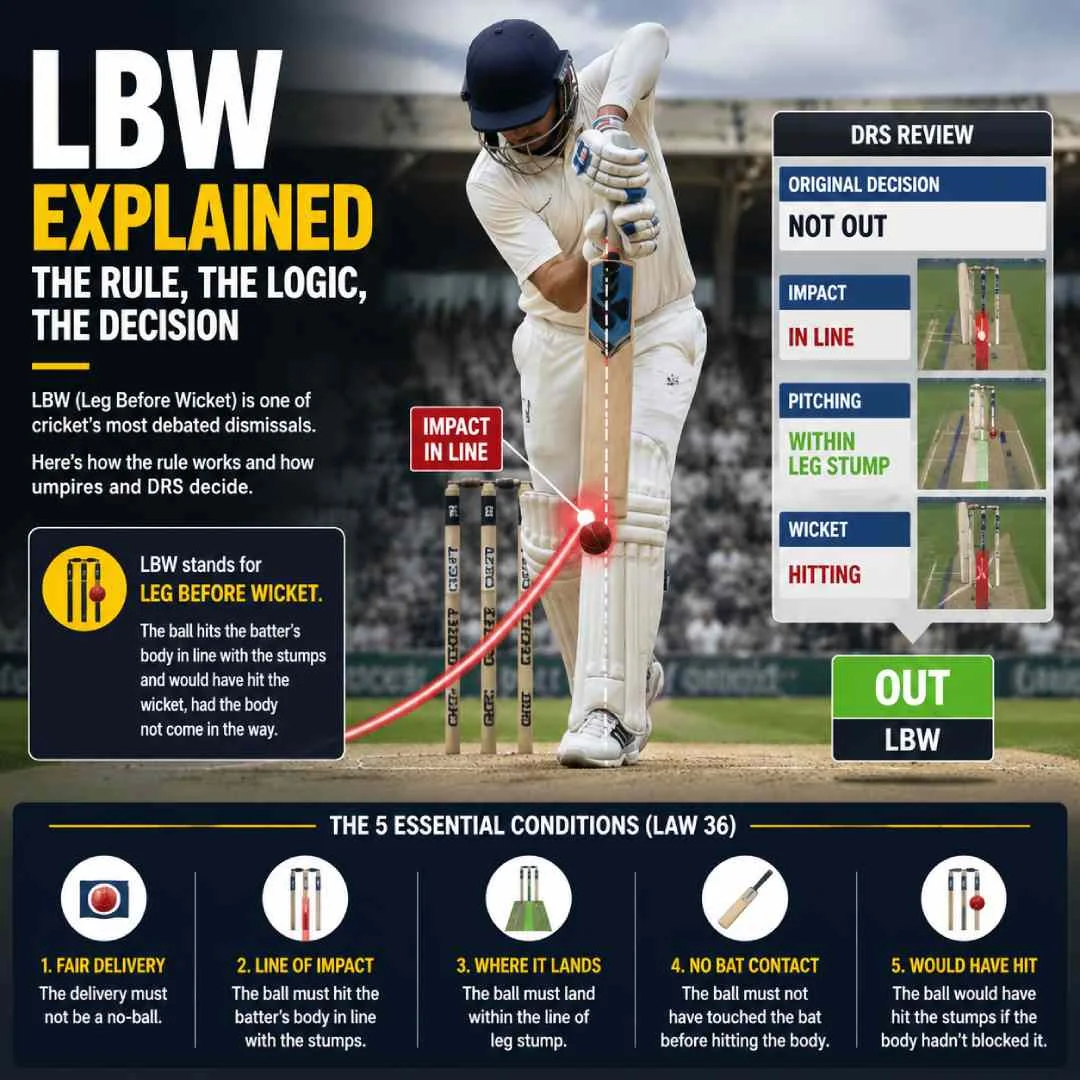
LBW stands for Leg Before Wicket. The dismissal happens when the ball strikes the batter’s body usually the leg rather than the bat, in a position where it would otherwise have hit the stumps.
The regulation exists for a simple reason: without it, batsmen might simply plant their pads in front of the stumps and block every delivery with their bodies rather than taking a shot. LBW protects the fundamental struggle between bat and ball.
The Official LBW Law: MCC Law 36
LBW is controlled by Law 36 of the Laws of Cricket, which was drafted and maintained by the Marylebone Cricket Club (MCC) at Lord’s, the same organization that has governed cricket’s laws since 1788. then ICC incorporates these laws into the official playing conditions for international cricket.
According to Law 36.1, a batter is out LBW only if all of the following apply:
- Fair delivery requires that the ball not be a no-ball.
- Line of impact – The ball must strike the batsman’s body (not the bat) in line with the stumps, or anyplace in line if the batter is not attempting a shot — with the exception of balls pitched outside off stump.
- Where the ball lands — The ball cannot land outside the leg stump.
- No bat contact first – The ball must not have touched the bat before striking the body.
- Would have hit the stumps – If the batter’s body had not intercepted the ball, the umpire believes it would have struck the stumps.
If any one of these five factors is not met, the correct ruling is not rendered no matter how close or dramatic the appeal appears.
It’s worth emphasizing that the ball can strike any part of the body – legs, thighs, torso, or even the shoulder and still qualify as long as it hits the stumps. Despite the name, the rule applies to more than just the pads.
What Changed in the 2026 Code of Laws
The MCC updates the Cricket Laws on a regular basis, and the latest version will go into effect on October 1, 2026. For LBW, the changes are mostly about clarity rather than substance: the MCC has reworded references to where the ball “pitches,” replacing that term with “lands” or “first landing,” to make the Laws easier to understand for players and fans all over the world, including those for whom English is not their first language. The five essential conditions of LBW remain unaltered in this iteration.
(Source: ICC Cricket Committee announcements, reported via Sportskeeda and ESPNcricinfo)
A Recent Rule Refinement Worth Knowing
One change to the ICC’s most recent playing conditions impacts how several appeals on a single ball are handled. If a batter is given out caught and replays show no bat involved but the ball did strike the pad, the third umpire will now check for LBW on that same review and if that check shows the batter out, the decision stands, even if the LBW angle alone would have been “Umpire’s Call.” Previously, this circumstance could be set to “not out.” When a single delivery results in multiple probable dismissals (for example, an LBW appeal and a run-out), the third umpire now considers them in the order that the events occurred, rather than always checking the umpire-referred one first.
(Source: ICC playing conditions update, reported via IPL.com)
Why LBW Shapes How the Game Is Played
The LBW law doesn’t just decide individual dismissals — it shapes tactics on both sides:
- Bowlers, particularly spinners, vary their length and line to trap batters in front of the stumps.
- Batters learn to keep their front foot and head in line, or to utilize their bat rather than a pad as the first line of defense, in order to avoid LBW.
- The confidence of umpires in reading the line, impact, and trajectory influences how frequently LBW appeals are upheld in practice, even with DRS as a backstop.
Building LBW awareness early for both batters and bowlers is considered as a key part of technique at structured coaching setups such as the Nerul Gymkhana Cricket Academy, rather than as rule trivia.
How to Build LBW Awareness Through Practice
A few habits can help players (and coaches) improve their awareness of LBW in real-world match situations:
- Watch the ball’s line, not simply where it pitches; line and impact are just as important as trajectory.
- Track the point of impact on the pad or body relative to the stumps, rather than whether the ball “looked close.”
- Examine umpire decisions in live matches and examine why a call happened the way it did, utilizing replays where available.
In net sessions, useful LBW-focused drills include bowlers deliberately targeting a stump-to-stump line, batters practicing forward and back press to properly cover the stumps, and short decision-making exercises in which players or young umpires call LBW appeals in real time to improve judgment under pressure.
Frequently Asked Questions
DRS employs ball-tracking systems to determine where the ball landed, the point of impact, and the anticipated path to the stumps. The “Umpire’s Call” margin implies that very close calls retain the on-field umpire’s initial decision rather than being reversed automatically.
Because it relies on determining the ball’s line, impact, and expected route in a fraction of a second. Even with DRS aid, marginal cases remain extremely close, making LBW a frequently discussed topic among players, commentators, and fans.
The fundamental five conditions in MCC Law 36 have not changed much in the 2026 Code of Laws; the modification primarily clarifies phrasing (for example, replacing “pitch” with “lands” for the ball’s landing spot). What has changed is how DRS administers the law, including the expanded striking zone and enhanced review-order regulations.
Structured coaching is most effective because it combines technical workouts with match awareness training. Gymkhana cricket coaching programs help to achieve this by providing targeted net sessions that cover both batting technique and bowling lines that produce LBW opportunities.
Yes, deliberately practising stump-to-stump bowling lines and forward/back push technique in the nets results in better decision-making and fewer soft dismissals (or missed opportunities) in real matches.


