



Pickleball is not only a sport but also a movement that is bringing players of all ages, from weekend warriors to retired pros, together. However, if you have recently bought a paddle, you might have figured out something that confuses most of the beginners: indoor and outdoor pickleballs look almost alike, but they feel quite different when you play.
So, what really makes them different?
We will break down the differences of pickleball balls in a way that is easy and useful for you to figure out which ball will be perfect for your next match.
1. What makes a pickleball different?
Maybe at the outset, a pickleball will make one think of a plastic wiffle ball, but unlike those common toys for backyards, pickleballs are made for a specific purpose and are balanced for the exact flight, bounce and control.
Each ball is made from strong, light plastic, which can be used on both indoor gym floors and outdoor asphalt surfaces. The biggest difference? It is the size, the number and the pattern of the holes of the pickleball that determine a great deal of how the ball behaves.
2. Hole patterns: The real game changer
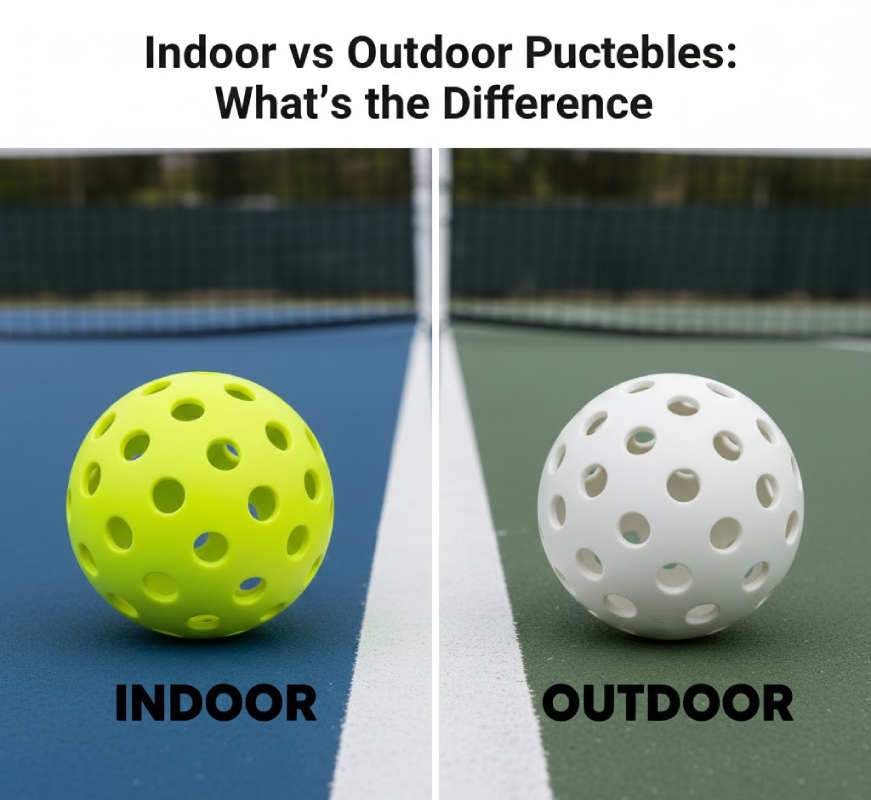
One immediate difference, “the holes” that you can see between an indoor and an outdoor ball, is that just putting them together.
Indoor pickleballs generally have 26 to 40 bigger holes (most often 26) thus they are lighter and slower in the air. The slower flight allows you more time to aim and control your shots; thus, it is perfect to use when drinking and rallying for a longer time.
Outdoor pickleballs usually have 40 small holes, which are wind-resistant and thus can increase the speed of the game. They are a little bit heavier, thereby providing both more stability and power when you make a move.
Due to this design difference, when it comes to indoor vs outdoor pickleballs, not only is the experience different, but also the changes in the way the ball bounces and the sound coming from the paddle.
3. Material and durability
Outdoor activities are not without their difficulties; heat, UV rays, dust and rough courts are some of the factors contributing to the reason
Outdoor pickleball balls are made of harder, more tightly packed plastic. They go longer without cracking, as they are faster and more resistant to breaking. Nevertheless, the same durability also makes them louder and a bit more difficult for your paddle.
In contrast, indoor pickleballs are produced from softer plastic. They are more silent, live and provide a more comfortable bounce on gym floors. The compromise? They get worn out quicker, especially if you use them in an outdoor setting.
If you are looking for good indoor pickleballs, select those that have a good balance between bounce and control and are soft enough for accuracy yet strong enough to last.
4. How does pickleball affect your game?
The ball you decide to use is the one that determines the overall feeling of your game.
Indoor pickleballs allow for more control; their slower speed results in more time for the player to position himself and thus, to hit the correct shots, which is the main reason why beginners are very fond of them. They facilitate the learning process and make the rallies longer.
Outdoor pickleballs are all about speed and power. Because they go faster, dancers have to be quicker at reacting, and this gives a more competitive edge to the game, which thus becomes the right field for experienced players who are into the kind of matches that are both intense and long.
Think of it this way: indoor balls are for finesse, outdoor balls are for firepower.
5. Bounce and sound: The hidden factors
Have you ever noticed that the sound of outdoor games is sharper and louder? This is because
Outer balls are built more firmly, and thus the sound of the shot is a sharper “pop” every time the ball hits the racket. Besides, they also bounce higher and faster.
Indoor balls bounce softer and quieter, which is a great advantage when one plays in enclosed places or community centres where the noise has to be kept to a minimum. The feeling is more controlled and forgiving, thereby allowing the players to concentrate on technique instead of force.
Playing at Nerul Gymkhana, one of the most popular venues for pickleball courts in Navi Mumbai, you must be able to see the difference quite clearly. A good number of players change from indoor to outdoor balls and vice versa, depending on the time of day and the level of the competition.
3. Material and durability
Outdoor activities are not without their difficulties; heat, UV rays, dust and rough courts are some of the factors contributing to the reason
Outdoor pickleball balls are made of harder, more tightly packed plastic. They go longer without cracking, as they are faster and more resistant to breaking. Nevertheless, the same durability also makes them louder and a bit more difficult for your paddle.
In contrast, indoor pickleballs are produced from softer plastic. They are more silent, live and provide a more comfortable bounce on gym floors. The compromise? They get worn out quicker, especially if you use them in an outdoor setting.
If you are looking for good indoor pickleballs, select those that have a good balance between bounce and control and are soft enough for accuracy yet strong enough to last.
4. How does pickleball affect your game?
The ball you decide to use is the one that determines the overall feeling of your game.
Indoor pickleballs allow for more control; their slower speed results in more time for the player to position himself and thus, to hit the correct shots, which is the main reason why beginners are very fond of them. They facilitate the learning process and make the rallies longer.
Outdoor pickleballs are all about speed and power. Because they go faster, dancers have to be quicker at reacting, and this gives a more competitive edge to the game, which thus becomes the right field for experienced players who are into the kind of matches that are both intense and long.
Think of it this way: indoor balls are for finesse, outdoor balls are for firepower.
5. Bounce and sound: The hidden factors
Have you ever noticed that the sound of outdoor games is sharper and louder? This is because
Outer balls are built more firmly, and thus the sound of the shot is a sharper “pop” every time the ball hits the racket. Besides, they also bounce higher and faster.
Indoor balls bounce softer and quieter, which is a great advantage when one plays in enclosed places or community centres where the noise has to be kept to a minimum. The feeling is more controlled and forgiving, thereby allowing the players to concentrate on technique instead of force.
Playing at Nerul Gymkhana, one of the most popular venues for pickleball courts in Navi Mumbai, you must be able to see the difference quite clearly. A good number of players change from indoor to outdoor balls and vice versa, depending on the time of day and the level of the competition.
6. Colour and visibility
Visibility is something that most players do not realise. Outdoor courts get sunlight and with that, come shadows and reflections, therefore balls that are either in bright neon yellow or in lime green are the best to use, while for indoor games orange or white balls provide better contrast under artificial lights, By simply changing the color, one can significantly reduce eye strain and make it easier to locate the ball during the rally.
Conclusion
7. Choosing the right pickleball for you
The perfect ball for you is determined by your playing location and style:
If you are a beginner, then indoor pickleballs are the best for you as they provide better control.
If you are going to play in tournaments or are a fan of fast-paced rallies, then you should choose outdoor pickleballs as they are more suitable for power and wind.
In case you are playing both? Just have a set of each and decide which to use at a particular time. It is always wise to see how different balls react on the court you prefer.
8. Keep your pickleballs in top shape
Giving them a little bit of attention will take them a long way. What you can do is the following to make your pickleball last as long as possible:
Keep them in a place that is not humid or hot, and that is either dry and shaded or if you happen to be living in such kind of weather, dry and shaded as well. Have several balls at your disposal during games and rotate among them so that you do not wear out one very quickly.
If you want to still be able to play consistently, then make sure you change cracked or misshapen balls immediately.
Outdoor balls generally crack with time, whereas indoor balls can become soft. Having a fresh stock at hand is the way to make sure every game feels fair and fun.
Pick your Ball, Pick Your Game
When it comes to indoor vs outdoor pickleballs, it is not simply a question of where you play but rather how you play. By using indoor balls, the player is benefiting from accuracy and strategy, while speed and stamina are pushed by outdoor balls.
If you need a venue to play pickleball in Navi Mumbai, Nerul Gymkhana provides high-standard pickleball courts in Navi Mumbai, an ideal place for you to put your new knowledge to use and find your perfect pickleball match.
2. Indoor vs Outdoor Pickleballs: What's the Difference? — FAQs
Indoor balls are softer with larger holes, while outdoor balls are harder with smaller holes for wind resistance.
You can, but they wear out quickly and don’t perform well in windy conditions.
Yes. Indoor balls have a slower, softer bounce, while outdoor balls bounce faster and more consistently.
Outdoor balls typically wear down faster due to rough surfaces, while indoor balls last longer.
{
“@context”: “https://schema.org”,
“@type”: “FAQPage”,
“mainEntity”: [
{
“@type”: “Question”,
“name”: “What is the main difference between indoor and outdoor pickleballs?”,
“acceptedAnswer”: {
“@type”: “Answer”,
“text”: “Indoor pickleballs are softer with larger holes, while outdoor pickleballs are harder with smaller holes to handle wind.”
}
},
{
“@type”: “Question”,
“name”: “Can I use indoor balls for outdoor play?”,
“acceptedAnswer”: {
“@type”: “Answer”,
“text”: “Indoor balls can be used outdoors but wear out faster and offer less predictable performance in windy conditions.”
}
},
{
“@type”: “Question”,
“name”: “Do indoor and outdoor pickleballs affect gameplay differently?”,
“acceptedAnswer”: {
“@type”: “Answer”,
“text”: “Yes. Indoor balls bounce softer and slower, while outdoor balls bounce faster and more consistently.”
}
},
{
“@type”: “Question”,
“name”: “How long do indoor and outdoor pickleballs last?”,
“acceptedAnswer”: {
“@type”: “Answer”,
“text”: “Outdoor balls generally wear out faster due to rough surfaces, while indoor balls usually last longer.”
}
}