












If you have recently taken a paddle in your hand and stepped on the court, it is quite possible that you found out that figuring out how to score in pickleball is almost as difficult as making the perfect serve. The scoring method in pickleball is a distinct one, different from that of tennis, badminton or ping pong and the key to understanding this is to have the maximum fun playing the game whether you play for leisure at your local community center or get ready for a pickleball tournament scoring match. This manual simplifies everything by going through it stepwise.
How to Score in a pickleball match?
Before going deep, here is the main rule:
Point scoring is only possible when your team is making a serve. The team that is receiving cannot score. That is the most basic difference between pickleball and other racquet sports.
A regular pickleball game of 11 points will require the winning team to have at least two points more than the losing one (e.g., 11-9 or 12-10). In tournaments, games may be played up to 15 or 21 points with the rule of “win by two” still being applied.
Now, let us break down the details of the pickleball scoring rules and how they actually work on the court.
2. Understand the pickleball scoring system
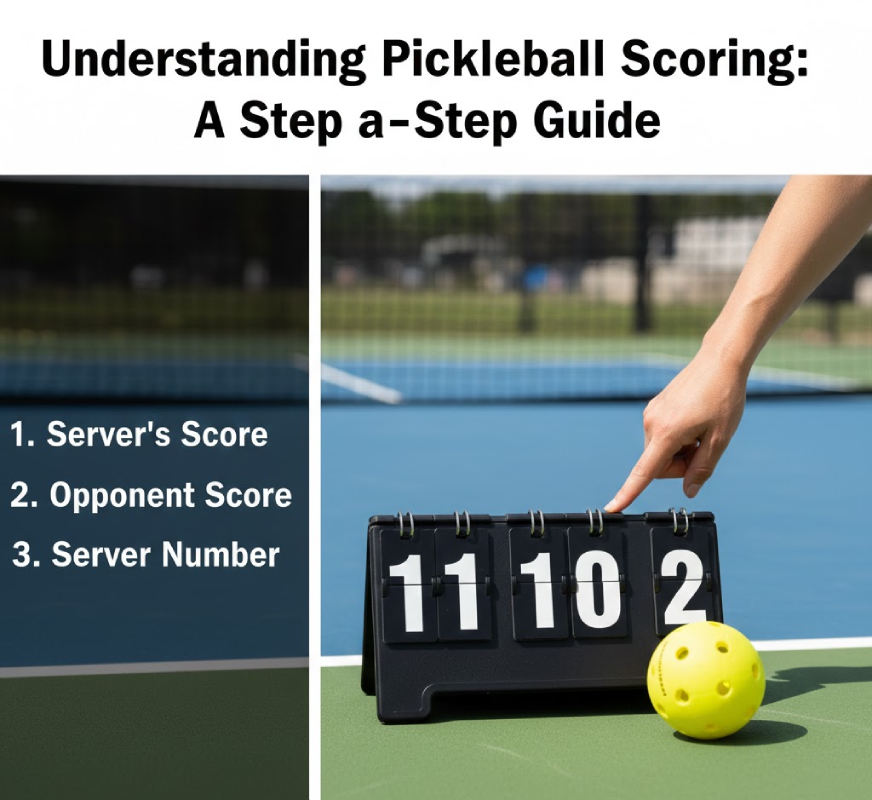
In doubles (the most typical format), the pickleball scoring system involves three numbers—like “4-2-1.” Each number has a significance:
First number: The score of the serving team.
Second number: The score of the receiving team.
Third number: The server number, either 1 or 2.
Thus, “6-3-2” means the team that is serving has six points, the opponents have three and the second server is currently serving.
In singles, it’s even easier, there is no third number, just the server’s and receiver’s scores (for example, “7-5”).
3. The serve and scoring rotation
This is the point at which most newbies are mistaken. In pickleball doubles, a team can have both members serving before the serve is given to the opposing team, except for the very first serve of the match. At the beginning of each match, only one player from the first serving team is allowed to serve. This is called the “first server exception.” The reason? To make it fair and stop one team from taking an early lead in the game.
After this, both partners serve one after another each time their team gets the serve. When both fail to hold their serve, the ball goes to the opponents.
Thus, if you have Team A serving:
Player 1 serves and loses the rally.
Player 2 is not allowed to serve
So the serve moves to Team B:
From that point forward, each time a team gets the serve back one player will be the server.
4. Keeping track of the serve
In doubles, players change sides every time they score a point. The server always begins from the right side when their score is an even number and from the left side when it’s odd, this is a simple trick to know your side without thinking too much.
Example:
If your team score is 4 (even) then serve from the right.
In case of 5 (odd), serve from the left.
It may take a couple of matches to fully grasp this rhythm, however, once you get this flow, it becomes natural as calling scores like “8-6-1”.
5. Pickleball tournament scoring
Pickleball tournament scoring for competitive matches usually remains the same but can have slight changes depending on the event. Some tournament formats consist of “best of three” games to 11 points, while others may be extended up to 15 or 21 points.
During tournaments, the referees usually announce the score before each serve to avoid any misunderstanding. If communication is wrong, it can lead to losing points, hence, always make sure of the score before serving, especially if you are involved in a heated rally or a close game.
6. Common scoring mistakes and how to avoid them?
Even professionals sometimes find themselves in a mix-up with numbers. Here are the common errors they make:
Confusing the first server: Be sure at all times which side started serving as this will help you keep track of the score later.
Wrong switching sides: Always verify whether your score is even or odd before starting the serve.
Not telling the complete score: Do not forget to say all three numbers prior to the serve (for instance, “5-4-2”).
Playing frequently at locations that are up to the mark like pickleball courts in Navi Mumbai, will allow you to practice under uniform rules with proper guidance. The presence of experienced player,s making learning easier and more enjoyable is an added advantage.
7. Why does understanding scoring in pickleball matter?
The thing is not merely about scorekeeping but rather that which helps you to upgrade your overall game awareness. Once you understand the scoring flow, you can better predict the rotations, talk efficiently with your partner and strategize smartly, knowing well how to score pickleball lifts your mental focus to a level where you keep your confidence and control even in high-pressure rallies and if you are willing to take your game to the next level in an environment that is supportive.
Nerul Gymkhana provides the best pickleball facilities in Navi Mumbai. Regardless of if you are a recreational player or seeking to achieve tournament-level mastery, it is the right place to learn, play and connect with other enthusiasts.
Conclusion
The process of learning the pickleball scoring system might be a bit confusing in the beginning, but it is this very thing that makes the game so unique and deep on a strategic level. After you have figured it out, scoring is something you do automatically, and thus you can put your entire focus on playing better and having fun.
So renew the surety of the scores, i.e. the court, why don’t you do that next time: “10-8-1” and with a smile serve. The reason is that when you know how scoring works, every rally becomes as thrilling as possible, every point as valuable and every match as pleasant. Take your paddle, go to the pickleball courts in Navi Mumbai, and live the excitement of the sport at Nerul Gymkhana!
4. Understanding Pickleball Scoring: A Step-by-Step Guide — FAQs
In doubles, the score is called as server score – receiver score – server number (0-0-2 to start).
No. Only the serving team can score points in traditional pickleball rules.
Typically, games are played to 11 points, and a team must win by 2 points.
Typically, games are played to 11 points, and a team must win by 2 points.
{
“@context”: “https://schema.org”,
“@type”: “FAQPage”,
“mainEntity”: [
{
“@type”: “Question”,
“name”: “How do you start scoring in pickleball?”,
“acceptedAnswer”: {
“@type”: “Answer”,
“text”: “In doubles, the score is called as server score, receiver score, and server number, starting with 0-0-2.”
}
},
{
“@type”: “Question”,
“name”: “Can you score points when you are not serving?”,
“acceptedAnswer”: {
“@type”: “Answer”,
“text”: “No. In traditional pickleball rules, only the serving team can score points.”
}
},
{
“@type”: “Question”,
“name”: “What score do you play to in pickleball?”,
“acceptedAnswer”: {
“@type”: “Answer”,
“text”: “Most games are played to 11 points, and a team must win by at least 2 points.”
}
},
{
“@type”: “Question”,
“name”: “What is a side-out in pickleball?”,
“acceptedAnswer”: {
“@type”: “Answer”,
“text”: “A side-out occurs when the serving team loses the serve and the opposing team gets the opportunity to serve.”
}
}
]
}